
In any industrial process, accurate measurement and control are the backbone of efficiency, safety, and productivity. Whether it’s monitoring pressure in a refinery or tracking temperature in a chemical plant, transmitters play a crucial role in ensuring that process variables are precisely measured and communicated to control systems.
This blog explores what transmitters are, how they function, their main types, and where they are used across industries.
What Is a Transmitter?
A transmitter is an instrument that converts the signal received from a primary sensor (like a thermocouple or pressure sensor) into a standardised output signal—most commonly 4–20 mA or digital (HART, Fieldbus, or Profibus). This signal is then sent to a PLC, DCS, or control room for monitoring and control.
In simple terms, transmitters act as the link between sensors and control systems, ensuring that data is transmitted accurately even over long distances or in harsh industrial environments.
How Do Transmitters Work?
The working of a transmitter involves three core stages:
- Sensing: The primary element (like a diaphragm, thermocouple, or float) senses a physical parameter pressure, temperature, level, or flow.
- Signal Conversion: This raw signal is converted into an electrical signal using electronic circuits inside the transmitter.
- Transmission: Finally, the transmitter sends a standardised electrical or digital signal to a controller or display unit for further processing.
For example, a pressure transmitter senses fluid pressure and converts it into a 4–20 mA signal proportional to that pressure, allowing operators to monitor and control it remotely.
Types of Transmitters
Transmitters come in different types depending on the parameter being measured. Below are the most common categories:
1. Pressure Transmitters
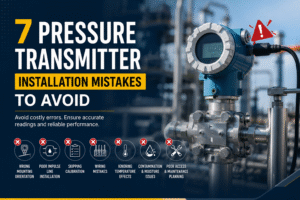
Used to measure the pressure of liquids or gases, these transmitters are vital in oil refineries, water treatment plants, and chemical industries.
They can be further classified as:
- Gauge Pressure Transmitters
- Absolute Pressure Transmitters
- Differential Pressure Transmitters
Example Application: Monitoring steam pressure in boilers or gas flow across filters.
2. Temperature Transmitters
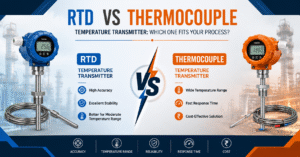
These convert signals from RTDs (Resistance Temperature Detectors) or thermocouples into standardised output signals.
They help ensure precise temperature control in furnaces, HVAC systems, and food processing lines.
Example Application: Measuring exhaust gas temperature in power plants.
3. Level Transmitters
Level Transmitters Designed to measure the level of liquids or solids, these transmitters prevent overflow and ensure consistent process operation.
Common types include ultrasonic, capacitance, and hydrostatic level transmitters.
Example Application: Maintaining chemical tank levels or monitoring water reservoirs.
4. Flow Transmitters
Flow transmitters measure the rate of fluid movement within a pipeline. They are used with flow meters like magnetic, turbine, or differential pressure types.
Example Application: Monitoring oil flow in pipelines or water discharge in treatment facilities.
5. Smart and Wireless Transmitters
Modern transmitters now integrate digital communication protocols like HART, FOUNDATION Fieldbus, or wireless technology. These devices not only transmit signals but also provide diagnostics, calibration data, and predictive maintenance insights.
Example Application: Remote process monitoring in large or hazardous areas.
Key Features and Advantages
Transmitters have evolved from simple analogue devices to intelligent digital systems. Here are some of their key advantages:
- High accuracy and repeatability
- Long-distance signal transmission
- Improved safety and process reliability
- Compatibility with industrial control systems
- Easy calibration and digital communication options
Smart transmitters also allow technicians to remotely configure, troubleshoot, and calibrate without interrupting the process, saving significant downtime.
Applications Across Industries
Transmitters are used in almost every process industry. Below are some examples:
Industry | Application Example |
Oil & Gas | Pressure monitoring in pipelines and offshore platforms |
Chemical | Level and flow measurement in reactors |
Water Treatment | pH and level transmitters in purification plants |
Food & Beverage | Temperature control in pasteurisation systems |
Power Generation | Steam pressure and temperature measurement |
Pharmaceutical | Maintaining sterile process conditions |
From ensuring precise dosing in pharmaceutical manufacturing to maintaining safety margins in chemical plants, transmitters play a vital role in preserving process integrity.
Choosing the Right Transmitter
Selecting the right transmitter depends on several factors:
- Measured variable (pressure, temperature, flow, or level)
- Operating conditions (temperature, pressure, environment)
- Accuracy and range
- Output signal type
- Material compatibility (especially for corrosive media)
Always consider consulting the instrumentation datasheet and process specifications before final selection to ensure reliable performance.
Maintenance and Calibration Best Practices
Regular maintenance ensures the long-term reliability of transmitters. Some key tips include:
- Periodically verify calibration using a reference standard.
- Check for electrical noise or loose connections.
- Keep transmitters clean and dry to avoid signal drift.
- Replace damaged seals and inspect diaphragms regularly.
Modern smart transmitters even feature self-diagnostics that alert operators when recalibration or replacement is needed.
Frequently Asked Questions (FAQs)
What is the primary purpose of a transmitter?
A transmitter converts a physical signal (like pressure or temperature) into an electrical signal for monitoring and control.
How is a transmitter different from a sensor?
A sensor detects a physical change, while a transmitter processes that signal and sends it to a control system.
What are the standard output signals from transmitters?
The most common output is 4–20 mA, but digital signals like HART, Fieldbus, and Profibus are also widely used.
How often should transmitters be calibrated?
Typically every 6–12 months, depending on the process environment and criticality of measurement.
What are smart transmitters?
Smart transmitters use digital communication and have built-in diagnostics, making them easier to maintain and more accurate than traditional analogue transmitters.