Choosing the right level detection device can make a significant difference in industrial efficiency, safety, and maintenance costs.
When it comes to point level detection in solids and bulk materials, two of the most commonly used technologies are tuning fork level switches and rotary paddle level switches. Both have their strengths, but the right choice depends heavily on your application.
In this blog, we’ll break down the key differences, advantages, and limitations of each to help you confidently decide between a tuning fork vs rotary paddle level switch.
Understanding Level Switches
Level switches are used to detect the presence or absence of material at a specific point in a container, silo, or tank. They are widely used in industries such as food processing, cement, chemicals, and agriculture.
The primary goal is simple: trigger an action (alarm, stop filling, start discharge) when material reaches a certain level.
What is a Tuning Fork Level Switch?
A tuning fork level switch operates using vibration technology. It consists of two prongs (like a tuning fork) that vibrate at a specific frequency. When material comes into contact with the fork, the vibration frequency changes. This change is detected by the electronics, triggering a switch signal.
Key Features:
- Works on vibration principle
- No moving mechanical parts
- Highly resistant to buildup
- Suitable for both liquids and solids
Advantages:
- Minimal maintenance due to lack of moving parts
- High accuracy and reliability
- Works well in low-density materials
- Not affected significantly by dust, moisture, or flow turbulence
Limitations:
- Generally more expensive than rotary paddle switches
- Requires power supply to operate
What is a Rotary Paddle Level Switch?
A rotary paddle level switch uses a small motor to rotate a paddle inside a bin or silo. When material reaches the paddle, it restricts movement. This resistance triggers a switch that signals the presence of material.
Key Features:
- Mechanical operation using a motor
- Rotating paddle detects material presence
- Widely used in bulk solids
Advantages:
- Cost-effective solution
- Simple design and easy installation
- Suitable for heavy bulk materials
- Widely available and well understood
Limitations:
- Moving parts are subject to wear and tear
- Not ideal for very light or powdery materials
- Can be affected by material buildup
- Requires regular maintenance
Tuning Fork vs Rotary Paddle Level Switch: Key Differences
When comparing a tuning fork vs rotary paddle level switch, several factors come into play:
- Operating Principle
Tuning fork switches rely on vibration frequency changes, while rotary paddle switches depend on mechanical resistance. - Maintenance Requirements
Tuning forks require very little maintenance because they have no moving parts. Rotary paddles, on the other hand, need periodic inspection and maintenance due to mechanical wear. - Material Compatibility
Tuning fork switches work well with powders, granules, and even liquids. Rotary paddles are better suited for heavier bulk solids but struggle with low-density materials. - Sensitivity
Tuning fork switches are more sensitive and can detect even slight material presence. Rotary paddles require enough force to stop the paddle rotation. - Durability
In harsh environments, tuning forks often last longer due to their robust, non-mechanical design. Rotary paddles may degrade faster in abrasive conditions. - Cost Consideration
Rotary paddle switches are generally more affordable upfront. However, tuning fork switches may offer better long-term value due to reduced maintenance.
When Should You Choose a Tuning Fork Level Switch?
A tuning fork level switch is the better option when:
- You are dealing with fine powders or low-density materials
- Maintenance access is limited
- You need high reliability and precision
- The environment includes dust, moisture, or vibration
- Long-term durability is a priority
Industries such as food processing, pharmaceuticals, and chemicals often prefer tuning fork switches for their reliability and cleanliness.
When Should You Choose a Rotary Paddle Level Switch?
A rotary paddle level switch is ideal when:
- You are working with heavy bulk materials like grains, cement, or pellets
- Budget constraints are a concern
- Simple operation is sufficient
- Maintenance access is easy
- The application is not highly sensitive
These switches are commonly used in agriculture, mining, and construction industries.
Cost vs Performance: A Practical Perspective
While rotary paddle switches may seem like the economical choice initially, the long-term costs can increase due to maintenance, downtime, and part replacement.
On the other hand, tuning fork switches require a higher initial investment but offer better performance stability and lower maintenance costs over time.
So, the real decision in the tuning fork vs rotary paddle level switch debate often comes down to whether you prioritize upfront cost or long-term efficiency.
Installation and Ease of Use
Both devices are relatively easy to install, but tuning fork switches have an edge due to fewer moving components and simpler calibration.
Rotary paddles may require torque adjustments and alignment checks, especially for different material types.
Environmental Considerations
If your application involves harsh environments with dust, humidity, or temperature variations, tuning fork switches tend to perform more reliably.
Rotary paddles may struggle in sticky or clumpy materials, where buildup can interfere with rotation.
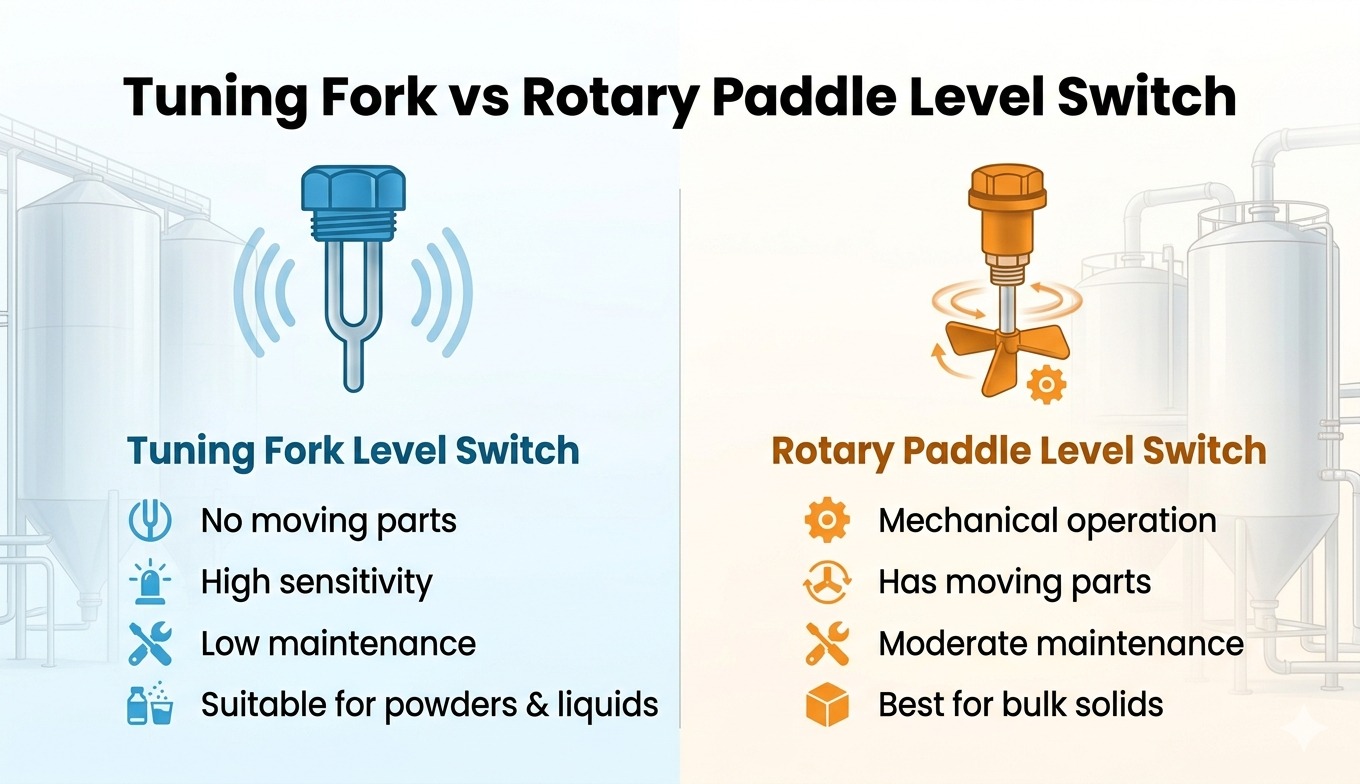
Infographic: Tuning Fork vs Rotary Paddle Level Switch
Feature | Tuning Fork Level Switch | Rotary Paddle Level Switch |
|---|---|---|
Working Principle | Vibration | Mechanical |
Moving Parts | No | Yes |
Maintenance | Low | Moderate to High |
Material Type | Powders & Liquids | Bulk Solids |
Sensitivity | High | Medium |
Durability | High | Moderate |
Cost (Initial) | Higher | Lower |
Long-Term Cost | Lower | Higher |
Buildup Resistance | Excellent | Limited |
Best Use Case | Precision & Low-Density Materials | Heavy Bulk Materials |
Final Thoughts
There is no one-size-fits-all answer when choosing between a tuning fork and a rotary paddle level switch. Each has its place depending on the application requirements.
If you need precision, reliability, and low maintenance, the tuning fork level switch is a strong investment. If your focus is on cost-effective solutions for heavy materials, the rotary paddle switch remains a practical choice.
Ultimately, understanding your material type, environment, and operational priorities will guide you to the right decision in the tuning fork vs rotary paddle level switch comparison.