If you’ve ever stood in front of a P&ID trying to figure out where a flame arrester goes and which type belongs there, you already know this isn’t a decision you can guess your way through. Get it wrong, and you’re either overpaying for protection you don’t need or leaving a pipeline exposed to a flashback it can’t stop. The inline vs end of line flame arrester question comes up constantly during plant design reviews, HAZOP studies, and equipment upgrades — and honestly, most engineers only fully understand the distinction after they’ve been burned (sometimes literally) by a wrong selection.
This guide breaks down exactly how these two arrester types differ, where each one belongs in your system, and how to make a selection that won’t get flagged in your next safety audit.
What Is a Flame Arrester, Really?
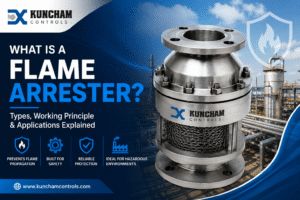
Before comparing types, let’s get the basics straight. A flame arrester is a passive safety device that stops a flame front from traveling through a pipe or vent and igniting flammable vapors on the other side. It doesn’t need power, sensors, or human intervention — it just physically quenches the flame using a matrix of narrow channels that absorb heat faster than the flame can propagate.
You’ll find these devices wherever flammable gases or vapors move through piping, storage tanks, or vent systems: refineries, chemical plants, tank farms, wastewater treatment facilities, and even breweries dealing with CO2 and ethanol vapors.
The two broad categories — inline and end-of-line — do the same fundamental job but sit in completely different spots in your process, and that placement changes everything about how they’re built.
Inline vs End of Line Flame Arrester: The Core Difference
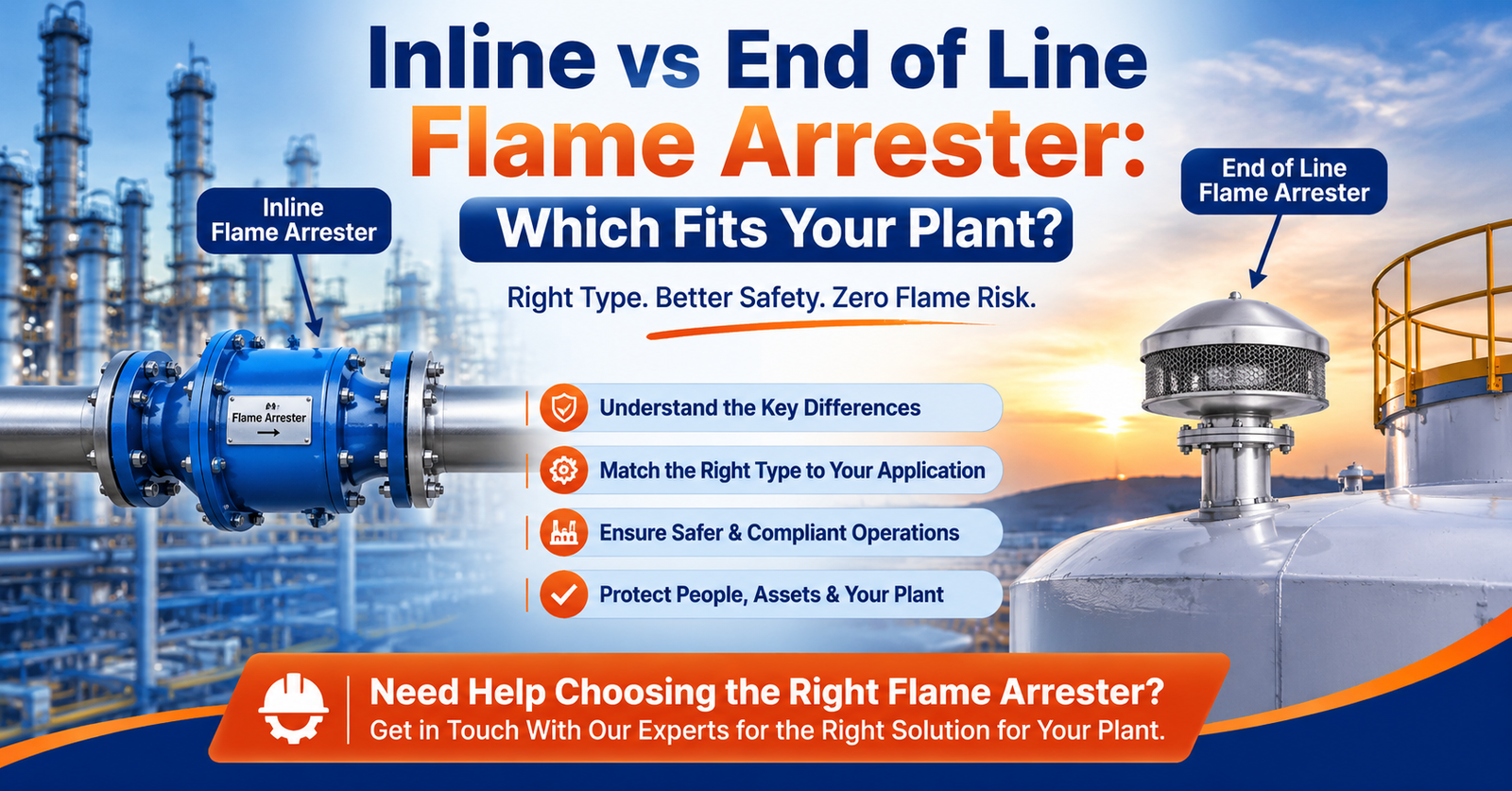
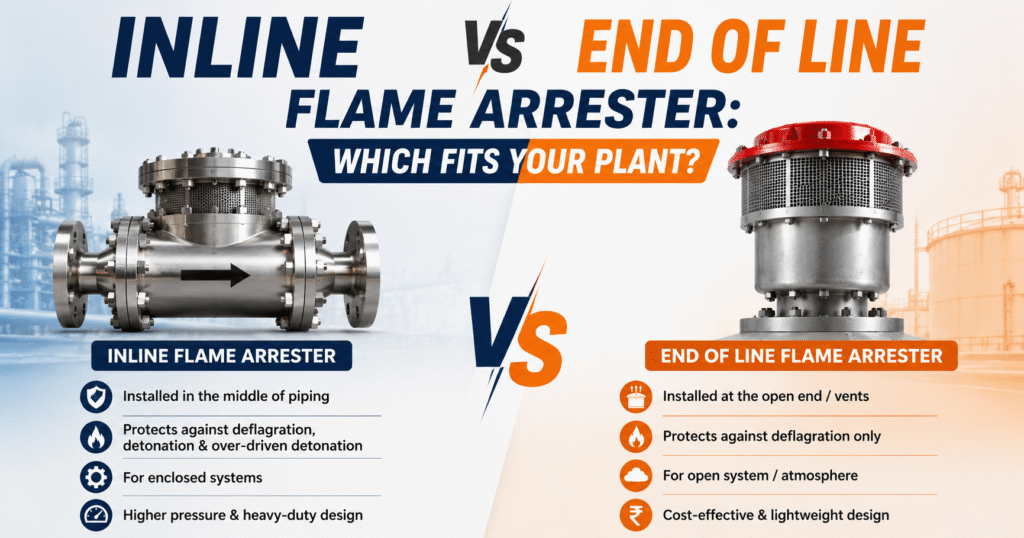
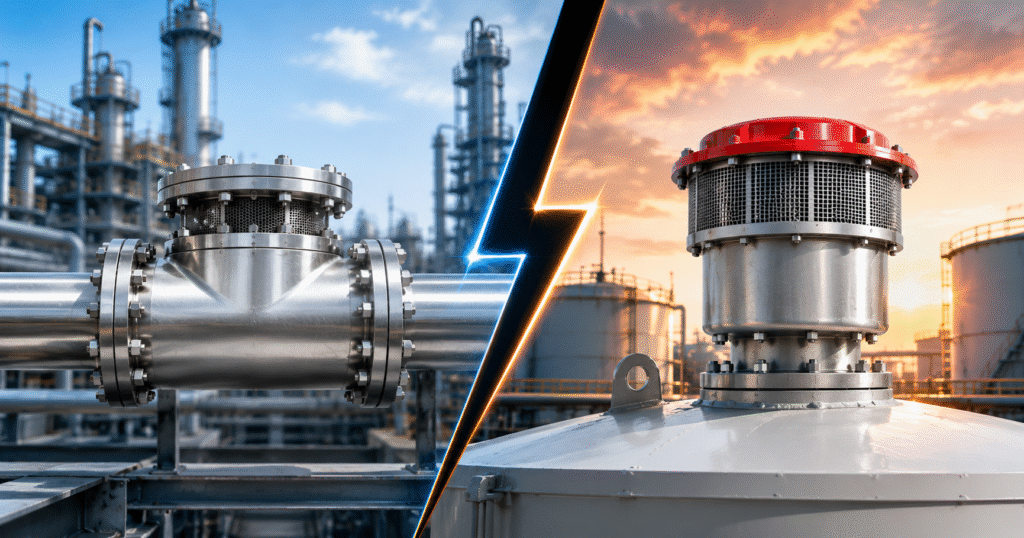
Here’s the short version, since this is the question everyone actually searches for: an inline flame arrester sits within a pipeline, between two points of the process, and must stop flames traveling in a fully enclosed system — often under detonation-level pressures. An end-of-line flame arrester (also called a vent flame arrester) sits at the open end of a pipe or tank vent, where one side is exposed to open atmosphere, and it typically only needs to handle deflagration, not detonation.
That single difference — enclosed system versus open atmosphere — drives nearly every design and cost decision that follows.
You’ll find these devices wherever flammable gases or vapors move through piping, storage tanks, or vent systems: refineries, chemical plants, tank farms, wastewater treatment facilities, and even breweries dealing with CO2 and ethanol vapors.
The two broad categories — inline and end-of-line — do the same fundamental job but sit in completely different spots in your process, and that placement changes everything about how they’re built.ISO/IEC 80079-49:2024
Inline Flame Arresters: Built for the Middle of the Pipe
An inline pipeline flame arrester is installed somewhere in the middle of piping runs, connecting two closed sections of a process. Think of transfer lines between tanks, vapor recovery piping, or compressor discharge lines.
Because both ends of the pipe are closed off, a flame that ignites can build pressure as it travels — sometimes transitioning from a slow deflagration into a supersonic detonation wave. That’s a massive difference in the forces the arrester has to survive.
Key traits of inline units:
- Rated for deflagration, stable detonation, or unstable (over-driven) detonation, depending on pipe length and geometry
- Built with heavier housings and more robust flame-quenching elements to handle higher pressure differentials
- Require careful positioning based on distance from the ignition source — this is called the “run-up distance”
- Often need periodic pressure-drop testing since they sit inside active flow paths
End-of-Line Flame Arresters: Guarding the Open End
An end-of-line flame arrester, sometimes called a vent flame arrester or tank vent protection device, mounts directly on a tank nozzle, vent stack, or breather valve — anywhere the pipe opens to atmosphere.
Since one side is open air, any flame that reaches the arrester is almost always still in the deflagration stage; it hasn’t had the confined runway needed to accelerate into a detonation. That’s why these units can usually be lighter, simpler, and less expensive than their inline counterparts.
Common applications:
- Storage tank vents (crude, solvents, fuel storage)
- Pressure/vacuum relief valve outlets
- Flare stack tips
- Atmospheric vent lines on process vessels
I’ve seen plant teams try to cut costs by using an end-of-line unit in what’s actually an inline application — usually because “it’s basically the same part.” It isn’t. The pressure classifications aren’t interchangeable, and that shortcut is exactly the kind of thing an insurance auditor or NFPA inspector will catch.
Detonation vs Deflagration: Why It Changes Your Selection
This distinction matters more than most people realize, so it’s worth slowing down here.
Deflagration is a subsonic flame front — it moves fast, but the pressure wave stays ahead of the reaction zone. Detonation is a supersonic shockwave where the pressure spike and flame front travel together, hitting speeds that can exceed 2,000 meters per second in the right conditions.
An arrester rated only for deflagration will fail catastrophically if a detonation wave hits it. This is precisely why:
- Long, straight pipe runs are more likely to develop detonation conditions (more room to accelerate)
- Inline arresters in these runs need detonation-rated designs, tested to standards like EN ISO 16852 or UL 525
- End-of-line arresters, sitting at open atmosphere, rarely see this transition — but you still need to verify pipe length upstream before assuming that
If your pipeline run exceeds roughly 50 pipe diameters without bends, you’re in the territory where detonation becomes a real possibility, not just a theoretical one.
Matching Gas Group and MESG to Your Media
Neither arrester type works as a generic, one-size-fits-all device. Both must be selected based on the Maximum Experimental Safe Gap (MESG) of the specific gas or vapor in your process, which determines the IIA, IIB, or IIC gas group classification.
- IIA — propane, natural gas, ammonia
- IIB — ethylene, most process solvents
- IIC — hydrogen, acetylene (the toughest to arrest, due to extremely small quenching gaps)
A flame arrester rated for IIA gases will not stop a hydrogen flame. This trips people up constantly during equipment reuse — someone repurposes an old arrester from a different unit without rechecking the gas group, and now you’ve got a device that looks right but fails the moment it’s actually tested.
Always cross-check your Safety Data Sheet’s flammability data against the arrester’s certified gas group before installation, regardless of whether you’re going inline or end-of-line.
Practical Selection Guide: Which Type Does Your Plant Need?
Use this quick framework when you’re staring at a P&ID and need to decide:
Situation | Recommended Type |
Vent/breather on a storage tank | End-of-line |
Transfer piping between two closed vessels | Inline |
Flare stack tip | End-of-line (deflagration-rated) |
Vapor recovery line, long straight run | Inline (detonation-rated) |
Pressure relief valve discharge to atmosphere | End-of-line |
Compressor suction/discharge line | Inline |
A good flame arrester selection guide always starts with one question: is either side of this arrester open to atmosphere, or is it fully enclosed on both ends? That answer alone eliminates half your options immediately.
From there, layer in:
- Operating temperature and pressure range
- Flow rate and expected pressure drop across the element
- Gas group / MESG classification
- Whether deflagration, stable detonation, or unstable detonation protection is required
- Housing material compatibility (stainless, aluminum, or specialty alloys for corrosive media)
If you’re working through an aging plant with poorly documented piping history, it’s worth bringing in a process safety engineer to verify run-up distances before assuming an existing end-of-line unit is still appropriate. [Link to related post] on process safety audits covers this in more depth if you want to go further.
Common Mistakes Plants Make With Flame Arrester Selection
A few patterns show up again and again in incident investigations and audit findings:
- Installing a deflagration-only arrester in a detonation-risk pipeline — usually because the original design didn’t account for a later piping extension that changed the run-up distance.
- Ignoring MESG mismatches after process changes — swapping feedstock or solvent without re-verifying the gas group.
- Skipping pressure-drop recalculations — a clogged or undersized arrester restricts flow and can trigger nuisance pressure alarms or even vacuum collapse on storage tanks.
- Treating end-of-line units as maintenance-free — they still need periodic inspection for corrosion, debris buildup, or element damage.
For reference on testing standards, the NFPA 69 standard on explosion prevention systems is a solid external resource if you want to dig into the regulatory side of arrester certification.
Conclusion
The inline vs end-of-line flame arrester decision really comes down to one structural question: is the pipe section open to atmosphere on one end, or closed on both? Get that right, then layer in gas group, detonation risk, and pressure conditions, and you’ll land on the correct device almost every time. Don’t treat this as a catalog-browsing exercise — a wrong selection here isn’t a minor spec error, it’s a safety gap waiting for the wrong day to matter.
If you’re mid-way through a plant safety review or piping upgrade and aren’t 100% sure which type your setup calls for, get a process safety specialist to walk your P&ID with you before you order equipment. It’s a lot cheaper than finding out the hard way.EN ISO 16852 flame arrester standard
FAQ
What is the main difference between an inline and an end-of-line flame arrester?
An inline flame arrester sits within a fully enclosed pipeline between two process points and is often rated for detonation-level pressure. An end-of-line (vent) flame arrester mounts where a pipe or tank vent opens to atmosphere and typically only needs deflagration protection.
When should I use an end-of-line flame arrester instead of an inline type?
Use an end-of-line flame arrester whenever one side of the connection is open to atmosphere — tank vents, PRV outlets, and flare tips are the classic cases. If both ends of the piping are closed off, you need an inline unit instead.
Can inline flame arresters handle detonation level pressure waves?
Yes, but only if they’re specifically certified for stable or unstable detonation, tested to standards like EN ISO 16852. Not every inline arrester is detonation-rated, so you have to check the certification against your actual pipe run-up distance.
Do both types need to match the gas group of the process media?
Absolutely — both inline and end-of-line arresters must be rated for the correct gas group (IIA, IIB, or IIC) based on the MESG of the specific gas or vapor involved. Using an arrester rated for the wrong gas group can mean it fails to quench the flame entirely.
How do I know which type my existing plant setup requires?
Check whether the piping section in question is open to atmosphere at any point — if yes, you likely need an end-of-line arrester there. If it’s a closed transfer line, especially a long straight run, get the pipe length and gas properties assessed to confirm whether inline detonation protection is required.