In modern process industries, accurate level measurement is critical for maintaining efficiency, safety, and product quality. Whether it is chemical processing, water treatment, food manufacturing, or oil and gas operations, industries rely on level measurement devices to monitor liquids, solids, and slurries inside tanks and vessels. Two of the most commonly used instruments are the level transmitter and the level switch. Although both devices are designed to measure or monitor material levels, they serve different purposes and operate in distinct ways.
Understanding the differences between a level transmitter vs level switch helps industries select the right solution for their applications.
What Is a Level Transmitter?
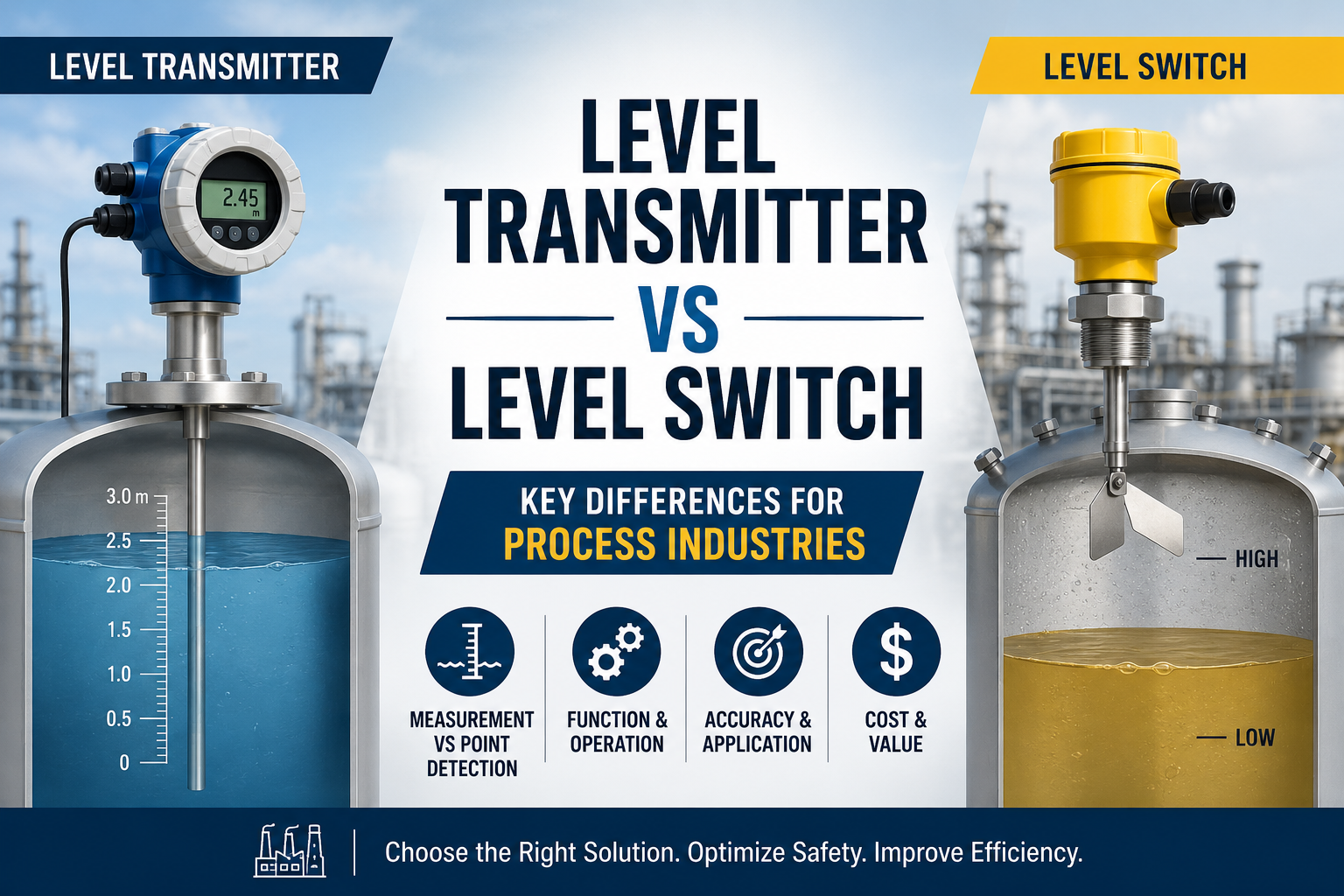
A level transmitter is a continuous measurement device that provides real-time level data of a substance within a tank or container. It measures the exact level and converts the information into an electrical signal, typically 4–20 mA or digital communication output, for monitoring and control systems.
Level transmitters are widely used in industries where precise and continuous level monitoring is required. Common technologies include:
- Ultrasonic level transmitters
- Radar level transmitters
- Hydrostatic level transmitters
- Capacitance level transmitters
These devices are integrated with PLCs, SCADA systems, and automation platforms to enable process optimization and remote monitoring.
Key Features of Level Transmitters
- Continuous level measurement
- High accuracy and reliability
- Suitable for automation systems
- Supports advanced process control
- Ideal for inventory management
What Is a Level Switch?
A level switch is a point-level detection device designed to trigger an action when the material reaches a predefined level. Unlike transmitters, level switches do not provide continuous measurement. Instead, they function as simple ON/OFF devices.
Level switches are commonly used for:
- High-level alarms
- Low-level alarms
- Pump protection
- Overflow prevention
Popular types of level switches include:
- Float level switches
- Vibrating fork switches
- Conductivity level switches
- Capacitive level switches
These devices are essential for safety applications where immediate response is needed once a specific level is reached.
Key Features of Level Switches
- Point-level detection
- Simple installation and operation
- Cost-effective solution
- Reliable for safety alarms
- Minimal maintenance requirements
Level Transmitter vs Level Switch: Main Differences
The primary difference between a level transmitter vs level switch lies in the type of measurement they provide.
| Feature | Level Transmitter | Level Switch |
|---|---|---|
| Measurement Type | Continuous | Point-level |
| Output | Analog/Digital signal | ON/OFF signal |
| Purpose | Monitoring and control | Alarm and protection |
| Accuracy | High | Moderate |
| Cost | Higher | Lower |
| Application | Process automation | Safety and indication |
A level transmitter continuously tracks the changing level inside a tank, making it suitable for process control applications. In contrast, a level switch only detects whether the level has crossed a specific point.
Which One Should You Choose?
The choice between a level transmitter and a level switch depends on your operational requirements.
Choose a level transmitter if:
- You need continuous monitoring
- Accurate inventory measurement is required
- The process involves automation and control systems
Choose a level switch if:
- You only need high or low-level alerts
- Cost is a major concern
- Simple overflow or dry-run protection is sufficient
In many industrial applications, both devices are used together to improve efficiency and safety.
Conclusion
When comparing level transmitter vs level switch, it is clear that each device plays a unique role in industrial processes. Level transmitters provide precise continuous measurement for advanced automation, while level switches offer dependable point-level detection for alarms and safety systems. Selecting the right instrument helps industries improve operational performance, reduce downtime, and maintain process safety.