If you manufacture flame arresters in India and you’re eyeing European or Middle Eastern export orders, one question decides whether you win or lose the deal: is your product ATEX certified? Buyers in hazardous process industries won’t even open your technical file without it. That’s not bureaucracy for its own sake — it’s because a flame arrester that fails during a real flashback event can level a tank farm.
This isn’t a small compliance checkbox. Getting ATEX or IECEx certification wrong costs Indian manufacturers months of delay, five- to six-figure rework bills, and sometimes a cancelled order altogether. In this guide, you’ll learn exactly what ATEX certification requires, how it differs from IECEx and PESO approval, what the process actually costs and takes, and where most Indian manufacturers stumble.
What Does ATEX Certification Mean for a Flame Arrester?
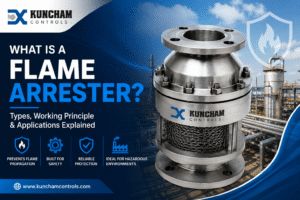
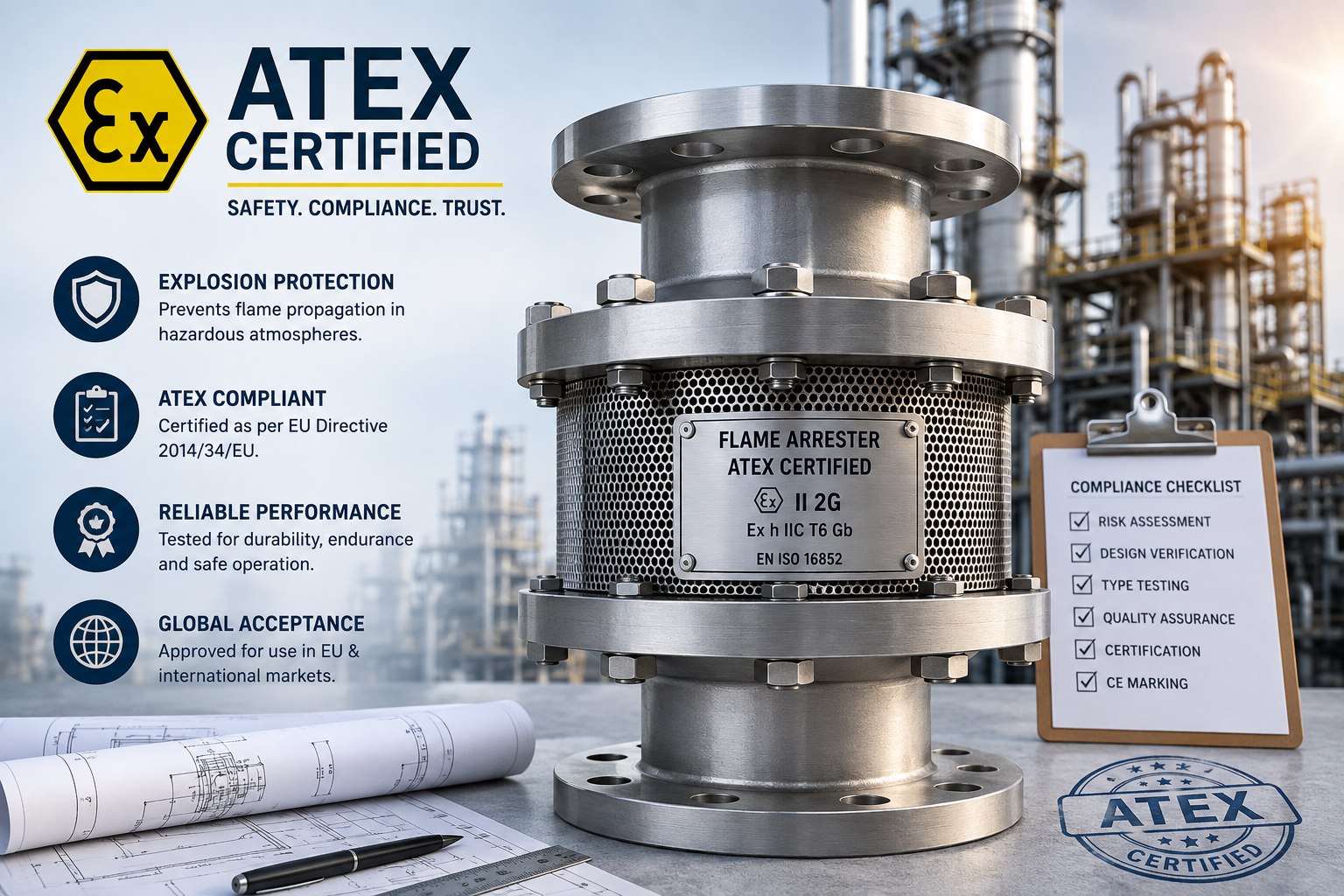
An ATEX certified flame arrester is a device that has been independently tested and approved under the European Union’s ATEX Directive 2014/34/EU, confirming it can prevent flame propagation in explosive atmospheres without becoming an ignition source itself. The certification covers both mechanical design and the equipment category rating (Zone 0, 1, or 2) it’s approved for.
Without this certification, you simply cannot legally sell flame arresters into the EU or European Economic Area for use in hazardous locations — refineries, chemical plants, tank farms, wastewater treatment, and similar sites. Distributors and EPC contractors will screen you out before your product spec sheet is even reviewed.
The Two ATEX Directives You Need to Understand
ATEX actually refers to two linked directives, and manufacturers often confuse them:
- 2014/34/EU — governs the equipment itself (your flame arrester, its housing, materials)
- 1999/92/EC — governs workplace safety obligations for the end user operating in hazardous zones
As a manufacturer, your certification obligation sits entirely with the first one. But understanding the second helps you have smarter conversations with your buyer’s safety engineers.
ATEX vs IECEx: Which One Do You Actually Need?
Here’s where a lot of confusion creeps in. ATEX is a European regional scheme; IECEx is the international equivalent, recognized in dozens of countries outside the EU including parts of the Middle East, Australia, and Southeast Asia.
Factor | ATEX | IECEx |
Recognition | European Union & EEA | Global (60+ countries) |
Legal basis | EU Directive 2014/34/EU | IEC Standard scheme |
Mandatory for | Selling in EU/EEA | Selling to IECEx-member countries |
Testing basis | EN standards (harmonized with IEC) | IEC 60079 series |
Notified Body required | Yes | Yes (Certification Body) |
Practically speaking, if your export strategy includes both Europe and the Gulf or Southeast Asia, pursuing both certifications together saves money. The underlying testing — flame transmission tests, MESG (Maximum Experimental Safe Gap) determination, pressure resistance — overlaps heavily, so a combined test campaign with your notified body cuts duplicate lab costs substantially.
One thing worth remembering: ATEX and IECEx certify the equipment, not the company. Every model variant — a pipeline flame arrester, a vent flame arrester, or a tank vent protection unit — needs its own certificate, even if they share a housing design.
The Certification Process: Step by Step

Getting a flame arrester certified isn’t a single audit — it’s a sequence, and skipping steps almost always backfires later.
- Classify the application. Decide whether the device is for deflagration or detonation service, and whether it’s an inline flame arrester or end-of-line flame arrester. This determines which EN/IEC test standard applies.
- Select your Notified Body / Certification Body. In the EU, only accredited Notified Bodies can issue ATEX certificates. TÜV, DEKRA, and SGS are common choices for Indian manufacturers because they have India-based liaison offices.
- Prepare the technical file. This includes design drawings, material certificates, risk assessment (per EN 1127-1), and a description of intended use.
- Type testing. The arrester undergoes flame transmission testing per EN ISO 16852 (or IEC 60079-XX for IECEx), including endurance burn tests where applicable.
- Quality assurance audit (Module D or similar). Your factory’s production process gets audited to confirm every unit produced matches the certified design — this is often where Indian manufacturers underestimate the documentation burden.
- Certificate issuance and CE marking. Once approved, you receive an EC-Type Examination Certificate and can apply CE marking alongside the Ex marking.
Realistically, budget 6 to 9 months for a first-time certification, and closer to 3-4 months for subsequent product variants once your QA system is already approved.
Selection Still Matters — Even After Certification
Certification tells a buyer the arrester works. It doesn’t tell them which arrester they need. Indian manufacturers who guide buyers through selection close deals faster than those who just quote a certified part number.
Inline vs End-of-Line: Get This Right First
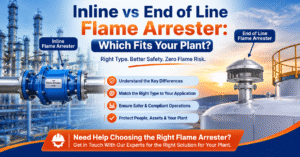
An inline flame arrester sits within a pipe run, typically between a vapor source and a flare or vent stack, protecting against flame travel through connected piping. An end-of-line flame arrester sits at a tank nozzle or vent opening, protecting the tank itself from external ignition sources like lightning or static.
Choosing wrong isn’t a paperwork error — it’s a safety failure waiting to happen. A detonation-rated inline arrester used in an end-of-line application, or vice versa, may not survive the actual flame front it’s meant to stop.
A Quick Flame Arrester Selection Guide
When advising buyers, walk them through:
- Gas group (IIA, IIB, IIC) — determines MESG requirements
- Flame regime — deflagration, stabilized detonation, or unstable detonation
- Operating pressure and temperature range
- Piping diameter and flow rate — undersizing causes excessive pressure drop
- Endurance burn requirement — is continuous burning expected, or is it a single-event device?
Getting even one of these wrong on a quote can mean re-engineering the entire order after the buyer’s process safety team reviews it.
PESO Approval: The Domestic Piece You Can’t Skip
Export certification gets most of the attention, but if you’re also selling within India — petroleum storage terminals, refineries, LPG bottling plants — PESO approval is non-negotiable. The Petroleum and Explosives Safety Organisation regulates hazardous area equipment domestically, and its approval process runs parallel to, not instead of, ATEX/IECEx.
A lot of Indian manufacturers assume ATEX certification automatically satisfies PESO. It doesn’t. PESO has its own application, its own testing references (often aligned to IS/IEC standards), and its own inspection regime. Plan for both if you’re serving domestic oil and gas alongside export markets.
Common Mistakes Indian Manufacturers Make
After years of watching manufacturers navigate this, a few mistakes show up again and again:
- Treating certification as a one-time event. Any design change — material substitution, weld pattern change, even a supplier switch for the flame cell — can invalidate your certificate if not managed through the QA system.
- Underinvesting in the technical file. Notified Bodies reject incomplete risk assessments constantly. A thin EN 1127-1 risk assessment is the single most common cause of delay.
- Ignoring gas group scope. A certificate scoped to IIA doesn’t cover IIB or IIC applications. Manufacturers sometimes discover this only after a buyer’s engineer flags it — well after the sale.
- Skipping the QA audit prep. Module D audits check your actual production line, not just your design office. If your shop floor can’t demonstrate traceability to the certified drawing, you’ll fail.
- Assuming one certificate covers all sizes. Larger diameter variants often need separate or extended testing, particularly for pressure resistance.
Working With the Right Testing Partner
Choosing a Notified Body isn’t just about price. Look for a partner with:
- Prior experience certifying flame arresters specifically (not just general Ex equipment)
- An India-based technical liaison to reduce document turnaround time
- A track record with EN ISO 16852 endurance testing, which is more specialized than basic Ex-equipment testing
For background on the standard itself, the International Electrotechnical Commission’s IEC 60079 series is the authoritative reference most certification bodies test against.
Conclusion
An ATEX certified flame arrester isn’t just an export requirement — it’s proof that your product will actually stop a flame front when it matters. For Indian manufacturers, the path runs through careful classification, a properly resourced technical file, rigorous type testing, and an ongoing QA discipline that keeps every unit matching the certified design. Get this right once, and you open doors to European, Gulf, and Southeast Asian markets simultaneously by pursuing ATEX and IECEx together.
If you’re planning your first certification cycle, start the technical file and risk assessment work now — it’s almost always the longest pole in the tent, not the lab testing itself.
FAQ
What is IECEx certification?
IECEx certification is an international scheme, based on IEC 60079 standards, that verifies equipment is safe for use in explosive atmospheres. Unlike ATEX, which only covers the EU/EEA, IECEx is recognized across 60+ member countries, making it useful for manufacturers exporting to multiple regions with one test campaign.
What is hazardous area equipment certification?
Hazardous area equipment certification confirms that a device — like a flame arrester, sensor, or enclosure — has been tested to operate safely in environments with flammable gases, vapors, or dust. It typically covers ignition prevention, enclosure integrity, and temperature classification, and is issued by accredited bodies under schemes like ATEX or IECEx.
How does PESO approval work in India?
PESO (Petroleum and Explosives Safety Organisation) approval is India’s domestic regulatory requirement for equipment used in petroleum and explosives handling facilities. It runs separately from ATEX or IECEx, requiring its own application, technical documentation, and inspection, even if the product already holds international certification.
What are explosion protection standards?
Explosion protection standards are technical requirements — such as EN 1127-1, EN ISO 16852, and the IEC 60079 series — that define how equipment must be designed, tested, and rated to prevent or contain explosions in hazardous atmospheres. They cover ignition source control, flame arrestment, and enclosure protection methods.
What is Ex-rated instrumentation?
Ex-rated instrumentation refers to sensors, controllers, and monitoring devices certified safe for use in explosive atmospheres, typically marked with an Ex symbol along with gas group and temperature class. This rating confirms the device won’t act as an ignition source under normal or fault conditions.
What is flameproof enclosure certification?
Flameproof enclosure certification (Ex d rating) verifies that an enclosure can contain an internal explosion without letting flame or hot gases escape to the surrounding atmosphere. It’s tested under IEC 60079-1 or the equivalent EN standard and is common for junction boxes, motors, and control panels in hazardous zones.