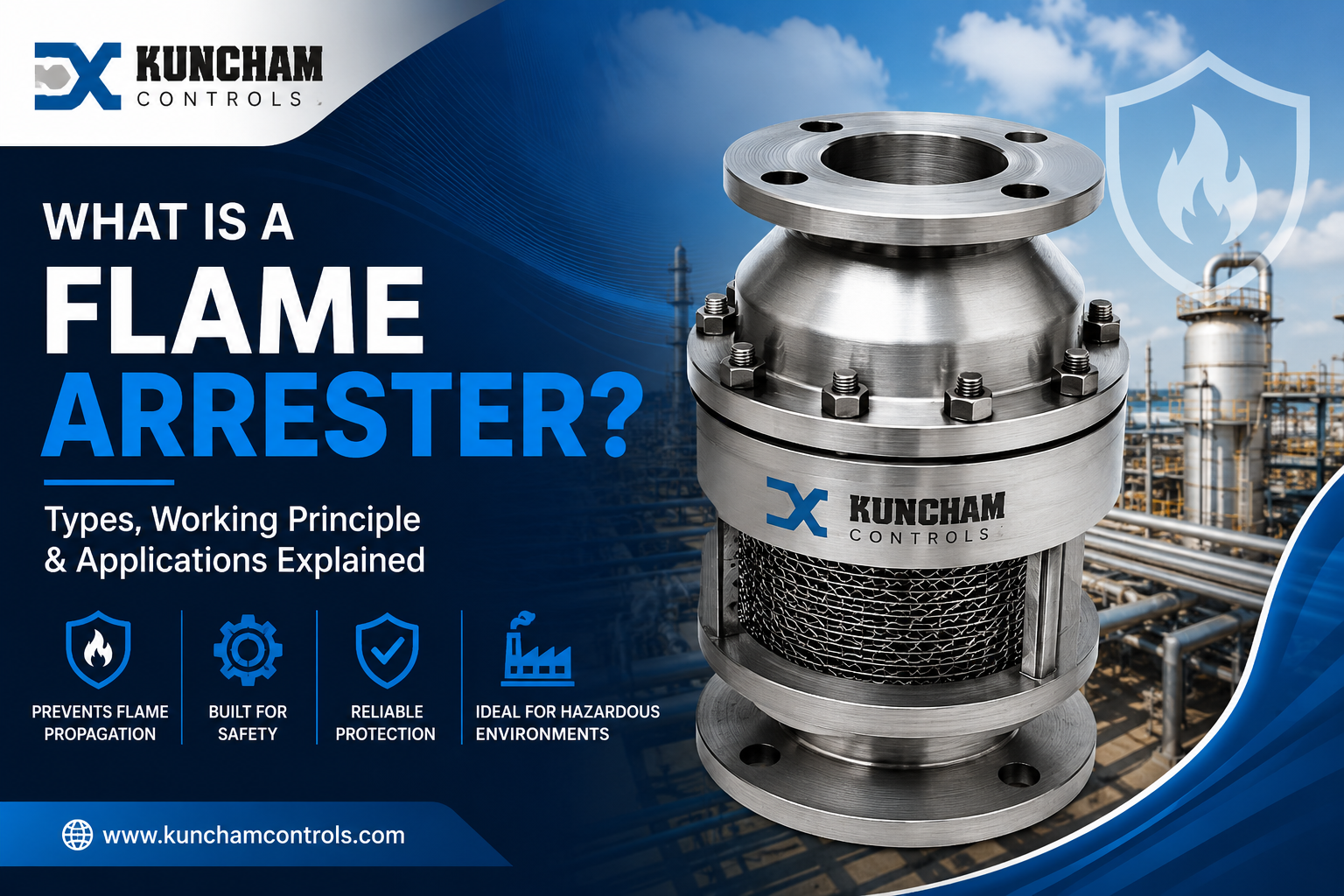
A flame arrester is a safety device that lets gas or vapor pass through a pipe or vent while physically blocking flames from traveling along with it. It works by forcing the flame through narrow channels that pull heat away faster than the flame can sustain itself, so the fire simply dies out before it reaches the other side. If you work anywhere near flammable liquids, gases, or fuel storage, this small piece of hardware is often the only thing standing between a contained vapor release and a full-blown explosion.
Most people outside the process safety world have never heard of a flame arrester, and that’s exactly the problem. It’s not glamorous equipment. Nobody shows it off. But ask any plant safety engineer what keeps them up at night, and a poorly maintained or incorrectly specified flame arrester will be somewhere on that list.
In this guide, you’ll learn what a flame arrester actually does, how it stops flame propagation at a mechanical level, the difference between deflagration and detonation types, where these devices show up in real industrial settings, and how to pick the right one without guessing.
What Does a Flame Arrester Actually Do?
Think of a flame arrester as a chokepoint built specifically to kill fire. Flammable vapors need three things to burn: fuel, oxygen, and enough heat to sustain combustion. A flame arrester doesn’t remove the fuel or oxygen — it attacks the heat.
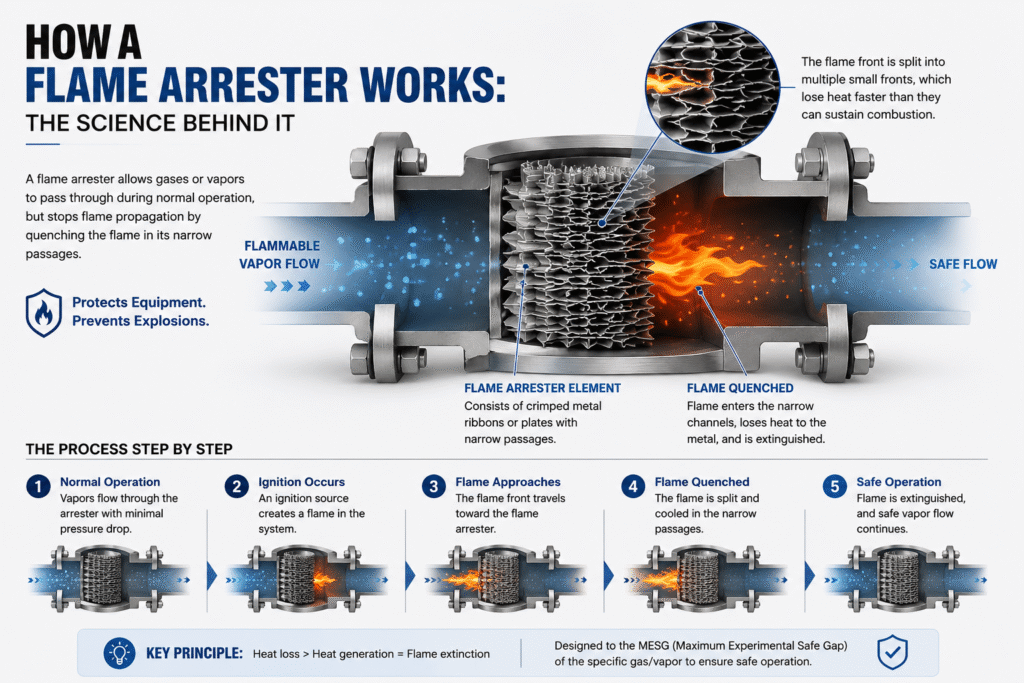
Inside the device sits a matrix of narrow passages, usually made from crimped metal ribbon, perforated plates, or stacked discs. When a flame tries to pass through this matrix, it gets split into thousands of tiny flame fronts. Each of those tiny fronts loses heat to the metal surrounding it faster than it can generate new heat through combustion. Within milliseconds, the flame is quenched.
This isn’t a filter. It’s not blocking gas flow at all under normal conditions — vapors pass through freely during everyday venting or breathing operations. The arrester only “activates” its safety function the moment a flame actually enters the system, which is a subtle but important distinction that trips people up when they’re first learning about flame propagation prevention.
How a Flame Arrester Works: The Science Behind It
The working principle rests on a concept engineers call the Maximum Experimental Safe Gap (MESG) — the widest gap through which a flame of a specific gas mixture cannot propagate. Every arrester is designed around the MESG value of the gases it’s protecting against.
Here’s the sequence, step by step:
- Flammable vapor flows through the arrester element during normal operation, with minimal pressure drop.
- An ignition source — lightning, static discharge, a spark from nearby equipment — ignites the vapor somewhere in the pipe or vent.
- The flame front travels toward the arrester.
- As it enters the narrow channels, the flame is split and rapidly cooled by contact with the metal element.
- Heat loss exceeds heat generation, and the flame extinguishes before it can cross to the protected side.
The element’s channel width has to be smaller than the MESG for the specific gas involved. Hydrogen, for instance, has an extremely small MESG and needs much tighter channels than something like propane. This is why you can’t just grab any flame arrester off a shelf — it has to match the gas group it’s protecting.
Types of Flame Arrester You Need to Know
Flame arresters are generally classified two ways: by the type of explosion they’re designed to stop, and by where they sit in the piping system.
Flame arresters are generally classified two ways: by the type of explosion they’re designed to stop, and by where they sit in the piping system.
Deflagration Flame Arrester
A deflagration flame arrester handles slower-moving flame fronts — typically under the speed of sound — where the pressure wave and flame travel together in a relatively controlled manner. These are the most common type you’ll see on storage tank vents, breather valves, and low-pressure vapor recovery lines.
Detonation Flame Arrester
A detonation flame arrester is built for a much more violent scenario: flame fronts that have accelerated past the speed of sound, generating shockwaves and extreme pressure spikes. This usually happens when a flame travels a long distance down a straight pipe before reaching the arrester, picking up speed the whole way. Detonation arresters are heavier, more robust, and engineered to survive pressures that would destroy a standard deflagration unit.
Mixing these two up is one of the more expensive mistakes an engineering team can make. A deflagration arrester installed where a detonation is possible won’t just fail — it can become the ignition source for a much bigger event downstream.
End-of-Line vs. In-Line Arresters
- End-of-line (or vent) arresters sit at the open end of a pipe or tank vent, where vapors are released to atmosphere.
- Inline flame arresters are installed within a pipe run, often at multiple points along a vapor collection or transfer system, to stop flame propagation between connected vessels.
Where Are Flame Arresters Used? Real Applications
Flame arrester applications span pretty much any industry that handles flammable gases or liquids.
- Oil and gas refineries — protecting storage tanks, flare systems, and vapor recovery units.
- Chemical and petrochemical plants — on process vents and tank farms handling solvents, hydrocarbons, and reactive chemicals.
- Marine and shipping — tanker vessels carrying crude oil or refined products use arresters on cargo tank vents.
- Wastewater treatment — methane generated in digesters and lagoons is vented through arrester-equipped systems.
- Fuel storage terminals — gasoline and diesel storage tanks almost always carry deflagration arresters on their vent lines.
- Pharmaceutical and paint manufacturing — solvent recovery systems where vapor concentrations can reach flammable ranges.
I’ve seen plants treat flame arresters as a checkbox item during initial design, only to realize years later that a process change — a new solvent, a longer pipe run, a different gas mixture — quietly moved them out of spec. That’s usually how incidents happen: not because nobody installed a flame arrester, but because nobody re-evaluated it after conditions changed. Storage tanks may also use a breather valve cum flame arrester to combine tank pressure regulation with flame protection.
Flame Arrester as a Hazardous Area Safety Device
In classified hazardous areas — Zone 0, 1, 2 or Class I, Division 1/2 under NEC standards — flame arresters work alongside other protective measures like intrinsically safe wiring, explosion-proof enclosures, and pressure relief valves. They’re rarely the only line of defense, but they’re often the last mechanical barrier before a vapor release becomes a fire.
Standards bodies including API, ISO, and UL publish detailed testing protocols for these devices (API 2028 is a good starting reference point if you want to go deeper — [external link: API Publications]). Certification against these standards matters more than most buyers realize, because an arrester tested only for propane won’t necessarily perform the same way against a hydrogen-rich stream.
How to Choose the Right Flame Arrester
Picking a flame arrester isn’t something to eyeball. Get these details wrong and the device either restricts flow unnecessarily or fails to stop a flame when it matters.
- Identify the gas group. Match the arrester’s MESG rating to the specific flammable gas or vapor mixture in your system.
- Determine deflagration vs. detonation risk. Pipe length, diameter, and layout all affect whether a flame could accelerate to detonation speed.
- Check operating pressure and temperature. The arrester needs to handle your system’s normal operating range plus any expected upset conditions.
- Confirm installation location. End-of-line versus in-line placement changes the design requirements significantly.
- Verify certification. Look for testing to recognized standards (UL 525, EN ISO 16852, or similar) specific to your gas group.
- Factor in maintenance access. Some designs are far easier to inspect and clean than others — this matters more once the unit is actually in service.
If you’re unsure, loop in a process safety engineer before finalizing the spec. The cost of the wrong arrester is nothing compared to the cost of the incident it was supposed to prevent.
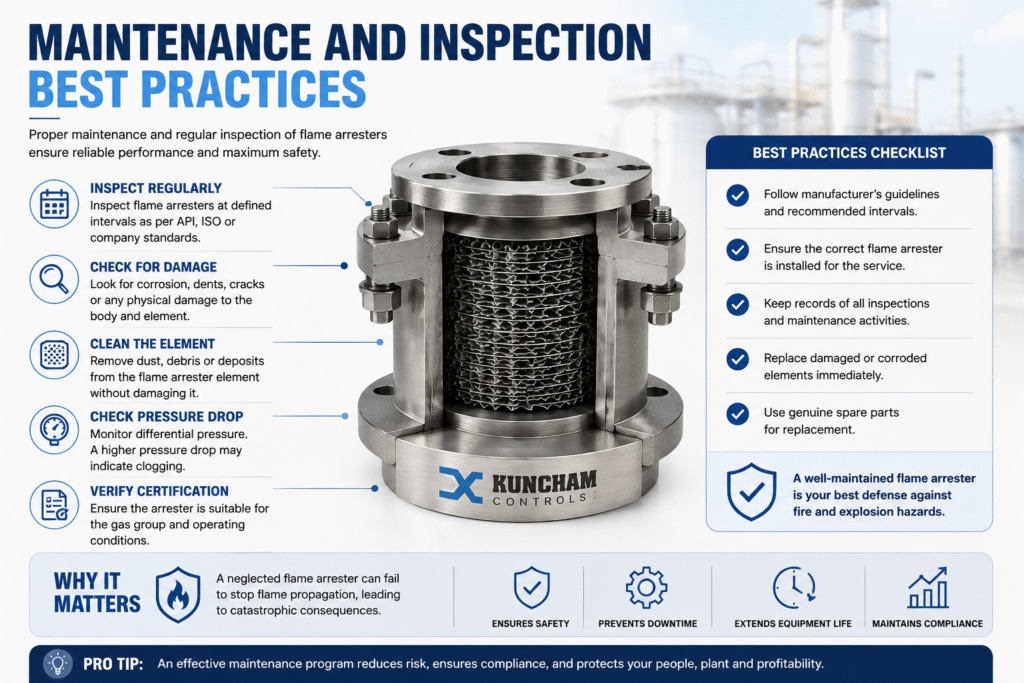
Maintenance and Inspection Best Practices
A flame arrester that’s caked in dirt, corrosion, or polymerized residue isn’t protecting anything — it’s just an expensive-looking obstruction. Regular inspection matters as much as correct selection.
- Inspect the element for blockage, corrosion, or damage at intervals set by your process conditions (dirtier services need more frequent checks).
- Clean using methods approved by the manufacturer — aggressive scrubbing can distort the narrow channels the whole device depends on.
- Check gaskets and seals for degradation, especially in high-temperature or corrosive services.
- Document every inspection. Regulators and insurers will ask for this history after any incident, and it’s a lot easier to produce records than to explain gaps in them.
Final Thoughts
A flame arrester might be the least appreciated piece of safety equipment on a plant floor, but it does one job extremely well: it stops a small vapor ignition from becoming a catastrophic event. Understanding the difference between deflagration and detonation types, matching the device to your specific gas group, and keeping up with inspections isn’t optional if you’re working with flammable materials — it’s the baseline. If your facility hasn’t reviewed its flame arrester specifications recently, particularly after any process changes, now’s a good time to do it before an incident forces the review instead.
FAQ
What is a flame arrester used for?
A flame arrester is used to stop flames from traveling through pipes, vents, or ducts carrying flammable gases or vapors. It allows normal gas flow while physically extinguishing any flame that enters the system, preventing fires or explosions from spreading between connected equipment.
What is the difference between a deflagration and a detonation flame arrester?
A deflagration flame arrester handles flame fronts moving slower than the speed of sound, typical of short pipe runs or open vents. A detonation flame arrester is built for much faster, high-pressure flame fronts that develop over longer pipe distances, and it’s engineered to withstand significantly higher shock loads.
Where are flame arresters typically installed?
Flame arresters are commonly installed on storage tank vents, breather valves, flare lines, vapor recovery systems, and pipelines carrying flammable liquids or gases. They’re used across oil and gas, chemical processing, marine transport, and wastewater treatment facilities.
How do I choose the right flame arrester for my application?
Match the device’s MESG rating to your specific gas or vapor group, determine whether you face a deflagration or detonation risk based on pipe layout, and confirm the arrester’s pressure, temperature, and certification match your operating conditions. Consulting a process safety engineer is recommended for complex or high-risk systems.
How often should a flame arrester be inspected or maintained?
Match the device’s MESG rating to your specific gas or vapor group, determine whether you face a deflagration or detonation risk based on pipe layout, and confirm the arrester’s pressure, temperature, and certification match your operating conditions. Consulting a process safety engineer is recommended for complex or high-risk systems.