
In industries where flammable gases or vapors are present, safety becomes a top priority. One crucial safety device used to prevent explosions and fire propagation is the flame arrester (also spelled flame arrestor). Whether in fuel storage tanks, diesel engines, or chemical processing units, flame arresters play a vital role in protecting people, property, and the environment.
In this article, we’ll explore what a flame arrester is, how it works, its types, applications, and some commonly asked FAQs
What is a Flame Arrester?
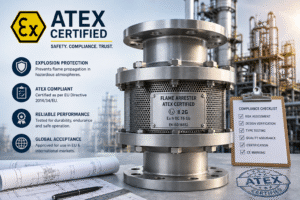
A flame arrester is a safety device designed to stop the propagation of a flame traveling through a gas or vapor mixture. It allows the gas or vapor to pass through, but prevents the flame from continuing beyond a certain point.
In simple terms, it acts as a barrier between a potential ignition source and a flammable atmosphere, ensuring that even if a flame does start, it cannot spread and cause further damage.
Flame arresters are widely used in:
- Fuel storage tanks
- Diesel tanks
- Gas pipelines
- Vent lines
- Vehicle fuel systems
- Chemical and petrochemical units
Flame Arrester Working Principle
The working principle of a flame arrester is based on heat absorption and flame quenching.
When a flame front travels through a pipe or vent line and reaches the arrester, it encounters a matrix of small channels or narrow passages—usually made of metallic elements such as wire mesh, crimped ribbons, or corrugated strips.
As the flame enters, these metallic components absorb the heat energy from the flame and cool it down to a temperature below the ignition point of the gas mixture. This process effectively extinguishes the flame and prevents it from passing through the arrester.
In summary:
A flame arrester works by cooling and dissipating the flame’s heat, stopping the combustion process from continuing downstream.
Flame Arrestor for Tanks
In fuel and chemical industries, storage tanks often contain volatile and flammable liquids. Vapors from these substances can form explosive mixtures with air, which pose a serious safety hazard.
To prevent external ignition sources—such as sparks, lightning, or static discharge—from igniting these vapors, end-of-line flame arresters are installed on tank vents.
An end-of-line flame arrester for tanks allows vapors to escape safely into the atmosphere while blocking any external flame from entering the tank.
These are essential for:
- Petroleum storage terminals
- Biofuel and ethanol plants
- Chemical processing industries
- Pharmaceutical and solvent storage units
Flame Arrestor for Vehicles
A flame arrestor for vehicles is designed to prevent the backfire of a flame into the fuel system. In vehicles using internal combustion engines, a backfire can cause flames to travel back through the intake system or fuel tank, leading to fire hazards.
Flame arrestors are commonly installed in:
- Vehicle fuel lines
- Diesel exhaust systems
- Marine engines
- Emission control systems
In diesel-powered vehicles, flame arrestors are used in fuel tanks and exhausts to ensure that hot gases or sparks cannot ignite the fuel vapors. This makes them essential components in automotive safety and marine applications.
Flame Arrester Types
Different flame arrester types are designed for specific industrial needs, based on the gas properties, pressure, and installation location. Below are the most common types:
1. End-of-Line Flame Arrester
- Installed at the end of a vent line or exhaust system.
- Protects tanks and vessels from external ignition sources.
- Used in fuel storage tanks, chemical containers, and biogas systems.
- Commonly referred to as end-of-line flame arrester for diesel tanks.
2. In-Line Flame Arrester
- Placed within pipelines that carry flammable vapors or gases.
- Prevents flame from traveling in either direction along the line.
- Used in process lines, transfer systems, and vapor recovery networks.
3. Deflagration Flame Arrester
- Designed to stop low-velocity flames (deflagrations) traveling at subsonic speeds.
- Installed near potential ignition sources in a system.
4. Detonation Flame Arrester
- Designed to withstand high-speed flames and pressure shocks (detonations).
- Suitable for long pipelines or systems where high-pressure gases are present.
5. Liquid Seal Flame Arrester
- Uses a liquid barrier, typically water, to absorb and extinguish flames.
- Commonly used in gas vent systems and low-pressure applications.
Flame Arrester Use in Industries
Flame arresters are essential safety devices across various industries where flammable gases or liquids are handled. Some of their major uses include:
- Oil and gas refineries – to prevent explosions in vent lines and storage tanks.
- Petrochemical plants – for safe vapor control and emission systems.
- Pharmaceutical industries – to handle volatile solvents safely.
- Biogas and wastewater treatment plants – to prevent ignition in gas lines.
- Marine and automotive sectors – to control backfire in fuel systems.
- Diesel storage tanks – for preventing flashback from external ignition sources.
Flame Arrester Price
The flame arrester price varies depending on several factors including type, material, size, brand, and certification.
Approximate price ranges in the market are:
- End-of-line flame arresters: ₹5,000 – ₹50,000
- In-line flame arresters: ₹20,000 – ₹2,00,000
- Custom industrial arresters: Up to ₹3,00,000 or more
Prices also depend on whether the arrester is designed for deflagration or detonation protection and the type of industrial standard (ATEX, CE, or ISO) it meets.
Flame Arrester Unit Components
A standard flame arrester unit consists of the following main parts:
- Housing: Typically made from stainless steel or aluminum for corrosion resistance.
- Flame element (core): The internal component that quenches the flame, made from corrugated metal ribbons or mesh.
- Gaskets and seals: Ensure a tight and leak-free connection.
- Flanges or threads: Used for easy installation on tanks or pipelines.
The flame element is the key component—it performs the actual flame-stopping function by dissipating heat energy.
Advantages of Using Flame Arresters
- Prevents explosion hazards in tanks and pipelines.
- Protects equipment, environment, and human life.
- Meets safety and regulatory compliance requirements.
- Requires low maintenance once installed.
- Compatible with various gas and vapor types.
- Available in multiple configurations for different applications.
Conclusion
Flame arresters are critical safety components in any system that handles flammable gases, vapors, or fuels. From end-of-line flame arresters protecting tank vents to in-line and detonation arresters safeguarding pipelines, these devices ensure the safe operation of process systems.
Whether used in diesel tanks, chemical plants, or vehicle fuel systems, choosing the right flame arrester type ensures maximum protection and compliance with industrial safety standards.
In short, flame arresters are small devices that provide a big layer of protection—helping industries prevent catastrophic explosions and maintain operational safety.
FAQ's
What does a flame arrester do?
A flame arrester prevents a flame from traveling through a flammable gas mixture. It allows gases to flow but blocks and extinguishes any flame by cooling it below its ignition temperature.
What are the different types of flame arresters?
The main types of flame arresters include:
- End-of-line flame arrester
- In-line flame arrester
- Deflagration flame arrester
- Detonation flame arrester
- Liquid seal flame arrester
Where are flame arrestors required?
Flame arrestors are required wherever flammable gases or vapors are handled. Common locations include:
- Fuel storage tanks
- Biogas and chemical plants
- Diesel tanks
- Marine vessels
- Industrial process lines
How does a gas can flame arrestor work?
A gas can flame arrestor typically uses a metal mesh screen at the opening of a container. It prevents external flames from entering the container by absorbing the heat and extinguishing the flame before it reaches the fuel vapors inside.