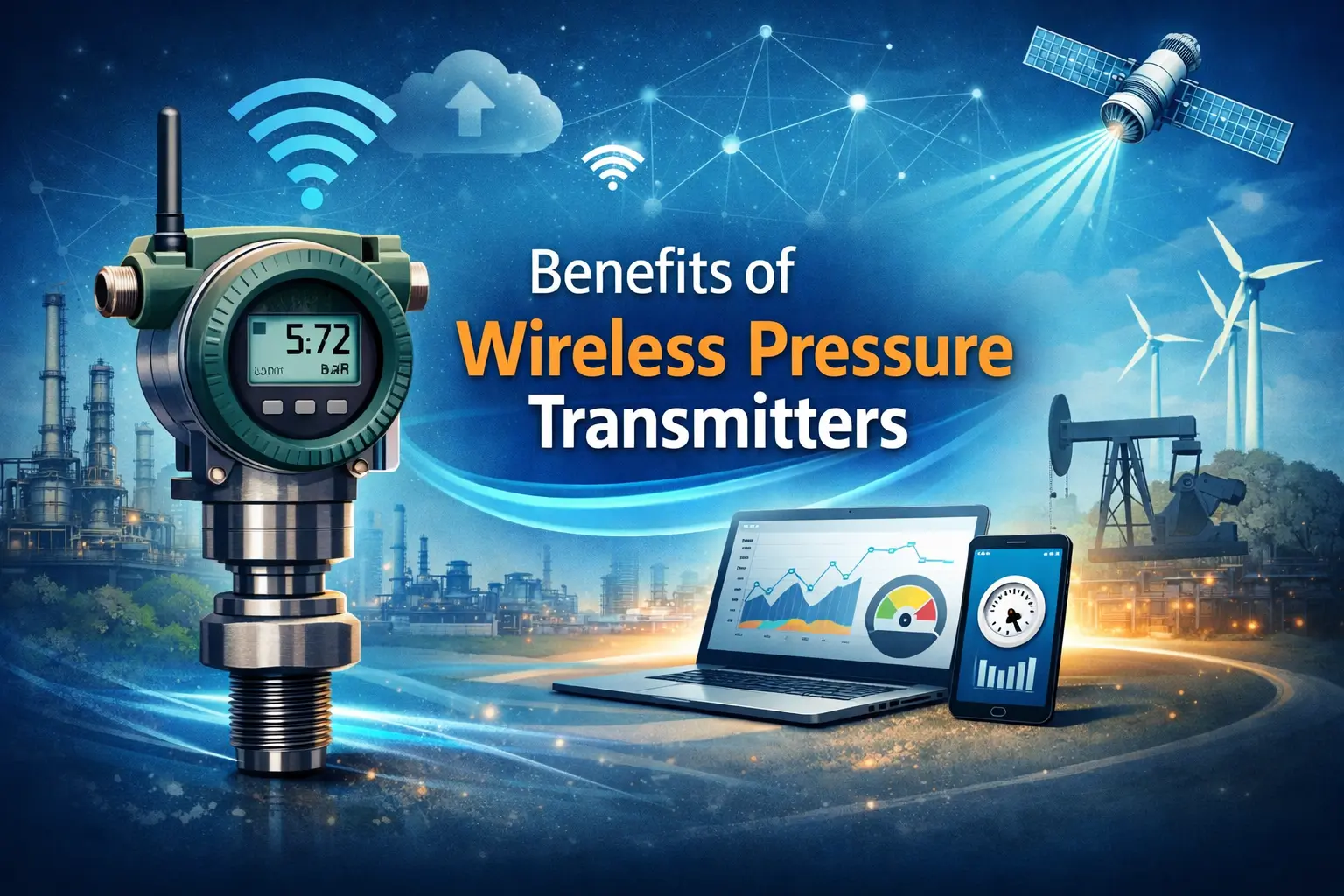
Industrial facilities are constantly evolving to improve efficiency, reduce downtime, and enhance safety. One major advancement that has transformed modern industries is the shift from traditional wired pressure transmitters to wireless pressure transmitters. These devices offer flexibility, ease of installation, and real-time data access—making them ideal for demanding environments such as oil and gas, water treatment, chemical plants, and manufacturing units.
Below, we explore the key benefits of using wireless pressure transmitters along with detailed insights into wireless pressure technology.
- Wireless Pressure Transmitter Advantages
Wireless pressure transmitters eliminate the need for long cable runs, reducing installation time, cost, and complexity. This makes them especially useful for remote or hard-to-reach locations.
Key Advantages:
- Lower installation cost: No cabling, trenching, or conduits required.
- Faster deployment: Units can be placed and activated within minutes.
- Flexibility in positioning: Install in challenging zones without worrying about wiring constraints.
- Easy scalability: Add more transmitters anytime without rewiring the entire system.
Industries adopt wireless transmitters mainly because they simplify setup while improving operational reliability.
- Wireless Pressure Sensor Benefits
Wireless pressure sensors offer several benefits over their wired counterparts, especially in dynamic industrial environments where mobility and response time matter.
Major Benefits:
- Enhanced mobility: Ideal for moving equipment or temporary monitoring.
- Reduced maintenance: Fewer wiring faults and wear-and-tear issues.
- Improved safety: Install sensors in hazardous zones without exposing workers to risk.
- Better access to trending data: Continuous data helps detect problems before failure occurs.
These benefits make wireless sensors a smart choice for industries seeking smooth operations with low maintenance demands.
- Wireless Pressure Monitoring
Wireless pressure monitoring allows operators to track pressure levels in real time, even across vast industrial facilities. This reduces downtime, prevents accidents, and improves decision-making.
Why Wireless Monitoring Matters:
- Real-time alerts and alarms: Receive updates instantly on control systems or mobile apps.
- Remote accessibility: Monitor pressure from anywhere, improving response time.
- Supports predictive maintenance: Continuous trends highlight unusual pressure patterns early.
- Safer monitoring: No need for technicians to physically access dangerous locations.
Wireless monitoring is especially valuable in industries where pressure variations can lead to safety hazards.
- Wireless Pressure Measurement
Accurate pressure measurement is fundamental for process control. Wireless technology ensures precise and consistent results while offering unmatched convenience.
Also read : Understanding Transmitters: Types, Functionality, and Applications
Key Advantages of Wireless Pressure Measurement:
- High accuracy and reliability: Many wireless transmitters rival wired devices in precision.
- Consistent data transmission: Reliable communication even in harsh conditions.
- Low power consumption: Long battery life with smart energy-saving features.
- Compatible with modern industrial systems: Easy integration with SCADA, DCS, and IoT platforms.
This combination of accuracy and convenience is why wireless pressure measurement is becoming the standard in advanced factories.
- Industrial Wireless Pressure Transmitters
Industrial wireless pressure transmitters are engineered to withstand extreme environments—heat, vibration, moisture, and chemical exposure. Their rugged design ensures maximum uptime and long service life.
Where Industrial Wireless Transmitters Excel:
- Oil & gas pipelines where wiring is expensive and unsafe
- Water and wastewater plants requiring constant monitoring
- Chemical factories with corrosive atmospheres
- Food & beverage plants demanding hygienic, cable-free installations
- Power plants where high temperatures make wired systems difficult
They provide industrial-grade strength with the added benefit of wireless flexibility.
- Wireless Pressure Technology
The backbone of wireless pressure transmitters lies in modern wireless pressure technology. This includes advanced sensors, long-range communication protocols, and ultra-low-power electronics.
Features of Today’s Wireless Technology:
- Long-range communication: Often up to several kilometers in open environments.
- Secure data transmission: Encrypted signals to protect sensitive industrial data.
- IoT and cloud integration: Enables analytics, reporting, and remote access.
- Low energy use: Smart sleep modes and efficient signal bursts extend battery life to 5–10 years.
- Self-diagnostics: Transmitters can detect internal issues and alert operators immediately.
As wireless pressure technology continues to evolve, industries are shifting rapidly toward smarter, more connected ecosystems.
Conclusion
Wireless pressure transmitters are transforming industrial operations by providing flexibility, accuracy, and cost-efficiency. From simplified installation and reduced maintenance to real-time monitoring and enhanced safety, the benefits are extensive. As industries continue to modernize, wireless pressure technology will play a key role in establishing intelligent, connected, and efficient automation systems.
Whether you’re upgrading an existing plant or building a new facility, wireless pressure transmitters offer a reliable and future-ready solution.
FAQ's
What are the advantages of wireless pressure transmitters?
They offer easy installation, lower cost, flexible placement, and reliable long-range communication.
How does wireless pressure monitoring work?
Wireless sensors send pressure data to a central system via radio signals, enabling real-time remote monitoring.
Are wireless pressure transmitters accurate?
Yes, modern wireless transmitters provide accuracy comparable to wired devices, often within ±0.1% to ±0.2%.
Where are industrial wireless pressure transmitters used?
They are used in oil & gas, water treatment, chemical plants, power plants, and manufacturing units.
How long do wireless pressure transmitter batteries last?
Battery life typically ranges from 5 to 10 years depending on transmission frequency and environmental conditions.
Are wireless pressure transmitters safe for hazardous locations?
Yes, many models are certified for ATEX, IECEx, and explosion-proof environments.
Can wireless pressure transmitters integrate with SCADA or IoT systems?
Absolutely — they are designed to connect with SCADA, DCS, PLC, mobile apps, and cloud-based IoT platforms.
Is wireless pressure measurement reliable in harsh environments?
Yes, rugged industrial transmitters withstand extreme temperatures, vibration, humidity, and chemical exposure.
Do wireless transmitters require regular maintenance?
Maintenance is minimal — mostly battery checks, periodic cleaning, and signal verification.
Is wireless pressure technology secure?
Modern systems use encryption and authentication to ensure safe data transfer.